This visualization starts with a wide-view of the Carina constellation and zooms down to the Hubble Space Telescope view of the massive star, AG Carinae. One of the brightest stars in our galaxy, AG Carinae...
This visualization starts with the Hubble Space Telescope view of the massive star, AG Carinae. One of the brightest stars in our galaxy, AG Carinae undergoes eruptions that have ejected a small nebula...
This visualization starts with a wide-field view of the Carina constellation and zooms down to the Hubble Space Telescope view of the massive star, AG Carinae. One of the brightest stars in our galaxy,...
The Whirlpool Galaxy, also known as Messier 51, is one of the nearest and best examples of a grand design spiral galaxy. Located about 25 million light-years away, the face-on galaxy exposes the full details...
The Pillars of Creation (Eagle Nebula, or Messier 16) are a stellar nursery, composed of gas and dust slowly eaten away by massive stars that are off the far to the upper right corner of this image. The...
Stars like our Sun end their lives by casting off their outer layers, briefly forming a spectacular planetary nebula like the Helix Nebula. In visible light, we see the glow of hot gases illuminated by...
The Sombrero Galaxy has a distinctive ring of dust that circles a smooth bulge of stars. The galaxy's dust and inner flat disk are very clear in the infrared. The Sombrero Galaxy may be a spiral galaxy...
Messier 82, or the Cigar Galaxy, is an edge-on spiral undergoing a massive burst of star formation in its core. Many thousands of stars, and their surrounding gas and dust, have been stirred up. These...
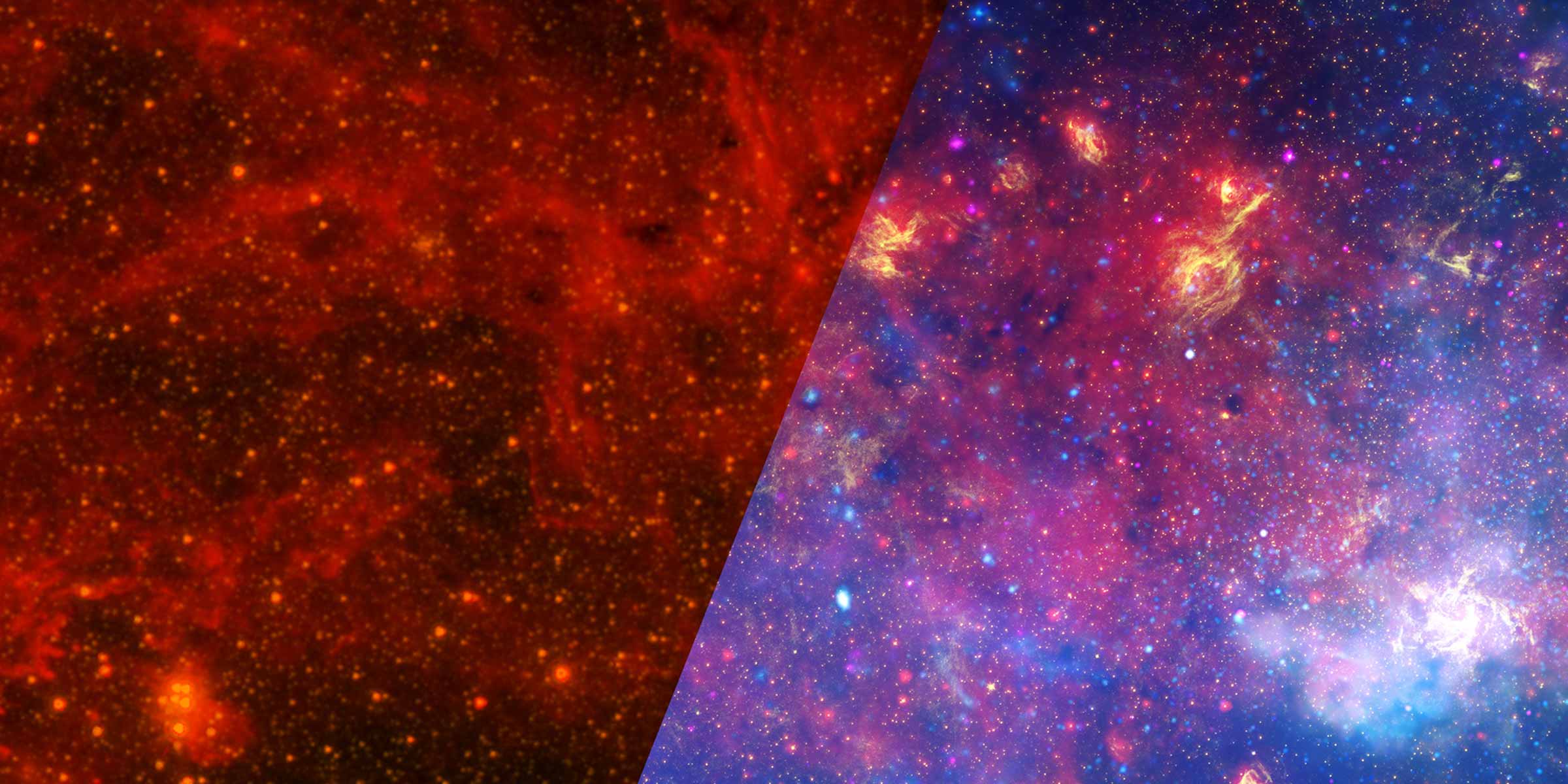
Our Solar System and Sun are located inside a pancake-shaped galaxy. Imagine a scale model where the plane of the Milky Way is a DVD, and the central bulge is a ping pong ball glued in the center. It is...
In 1604, astronomer Johannes Kepler noted the appearance of a new bright object in the sky, visible to the naked eye for the next 18 months. Today we know that he was seeing the death of a star 20,000...
This version of "Flight Through the Orion Nebula in Visible Light" has been rendered onto a hemispherical format (azimuthal equidistant projection) for use in planetarium domes. The black circular...
This version of "Flight Through the Orion Nebula in Visible and Infrared Light" has been rendered onto a hemispherical format (azimuthal equidistant projection) for use in planetarium domes....
This version of "Flight Through the Orion Nebula in Infrared Light" has been rendered onto a hemispherical format (azimuthal equidistant projection) for use in planetarium domes. The black circular...
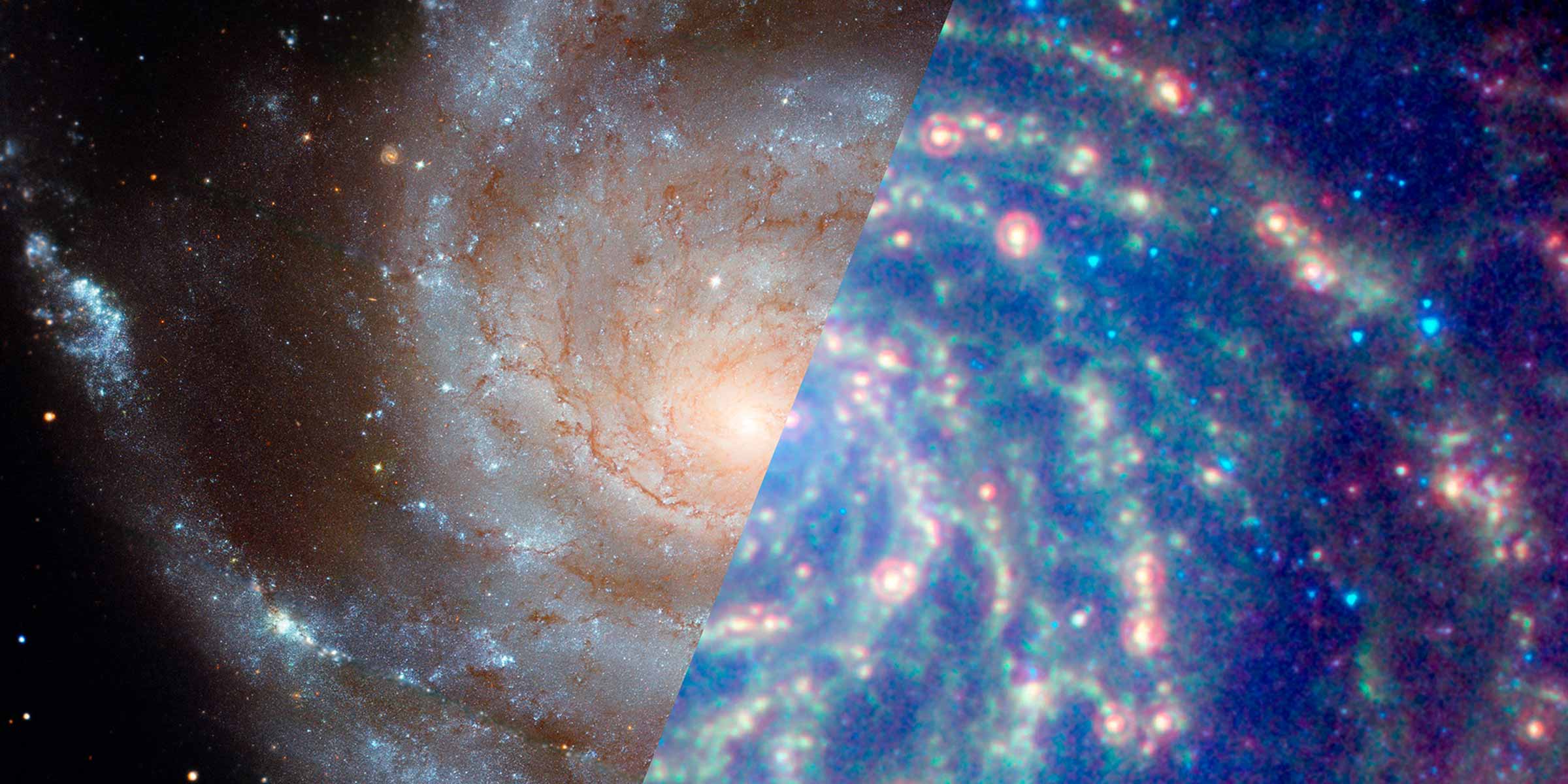
M101 is a comparable in size to the Milky Way. The disk is 100 billion solar masses, and the central bulge is about 3 billion solar masses. M101 is rich is pinkish star-forming regions, many of which are...
30 Doradus (the Tarantula Nebula) is a very bright and active star-forming region outside the Milky Way galaxy, at 160,000 light-years away. 30 Doradus is home to the central star cluster NGC 2070, including...