Hevelius Images
About Educational Resource
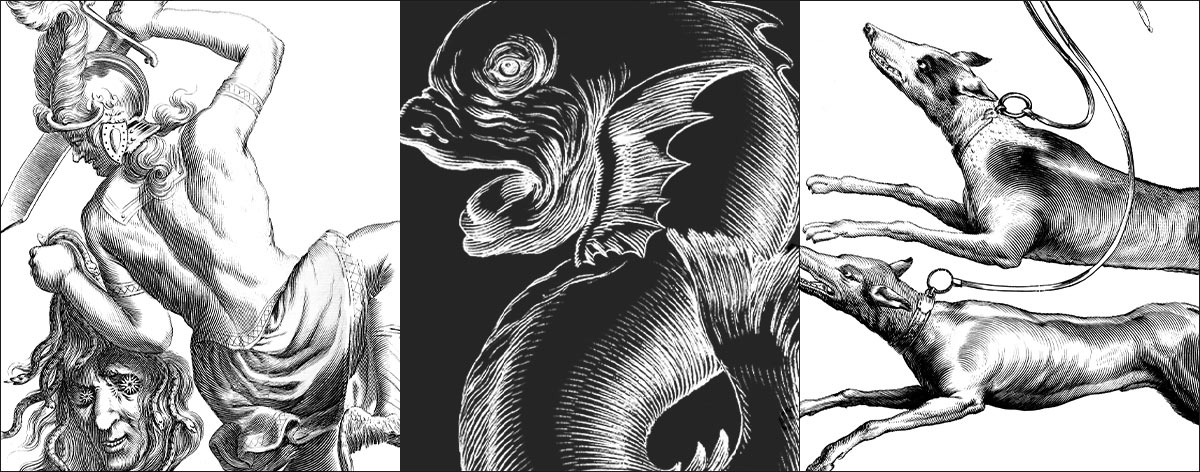
Celestial observers have carefully cataloged the locations of the stars for thousands of years. These atlases often noted the precise positions and brightnesses of individual stars, and were produced by people across the globe. In the 1600s, Johannes Hevelius spent decades developing, building, using, and writing about telescopes and astronomical tools. He also produced a star atlas, “Firmamentum Sobiescianum sive Uranographia,” which contains finely detailed engravings that represent figures, animals, and objects that trace constellations. These detailed illustration files are available below to use in non-commercial applications. We acknowledge that these illustrations represent only one cultural perspective.
There are several file formats to choose from, along with two viewing angles. Hevelius pictured the celestial sphere as if he was capturing what is seen when looking down on Earth. Illustrations from this perspective are found in the second sets of files.
To make it easier to add these figures to planetarium domes, designers mirrored the illustrations so they appear as if you are staring up at them from Earth. These are found in the first sets of files. Every download offers the complete set of Hevelius illustrations in a specific file type from a single angle. They are all designed to appear in front of a star field of your choosing.
When using these files, please credit the U.S. Naval Observatory and Space Telescope Science Institute.
Image